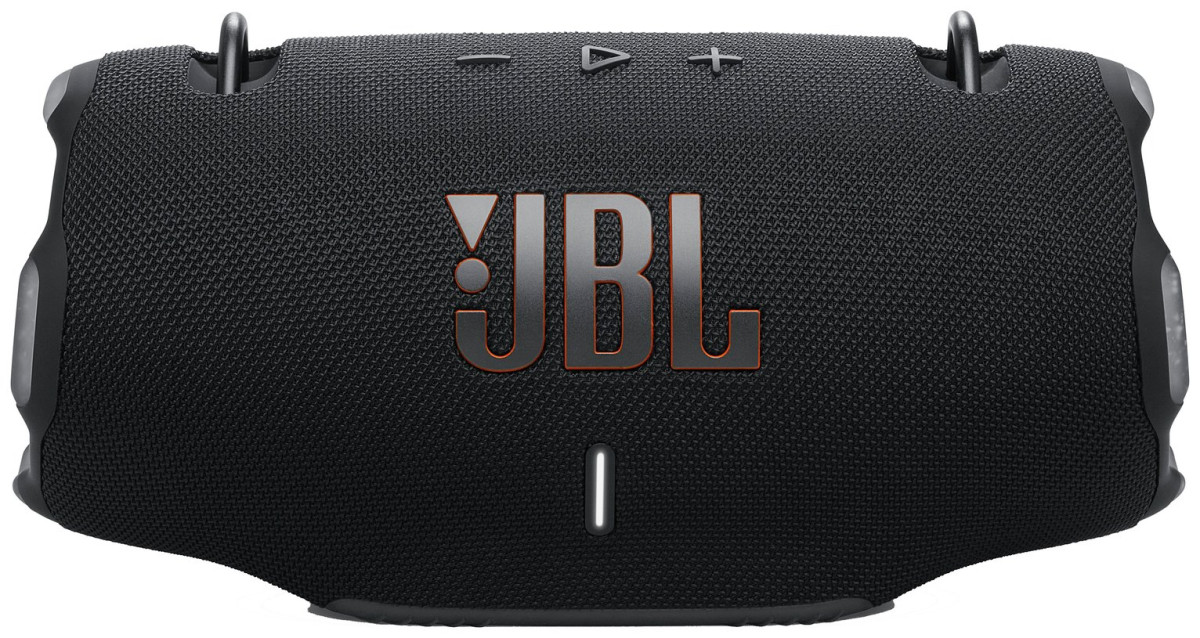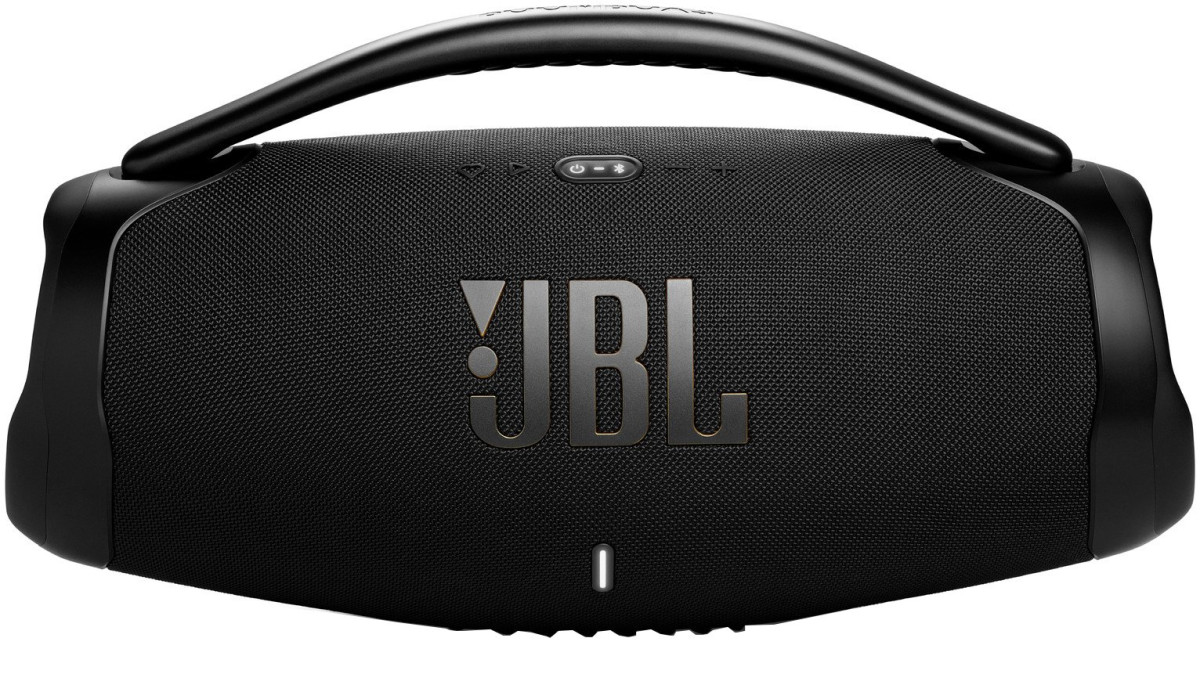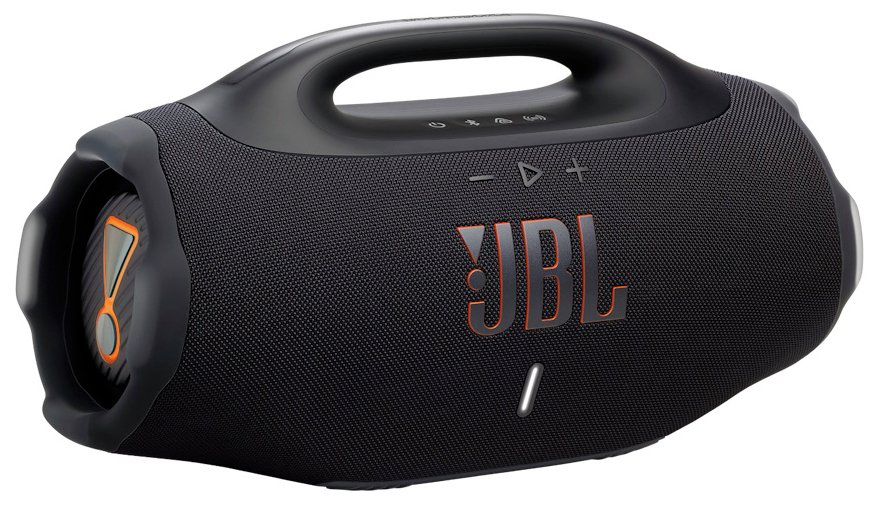
JBL Boombox 4
JBL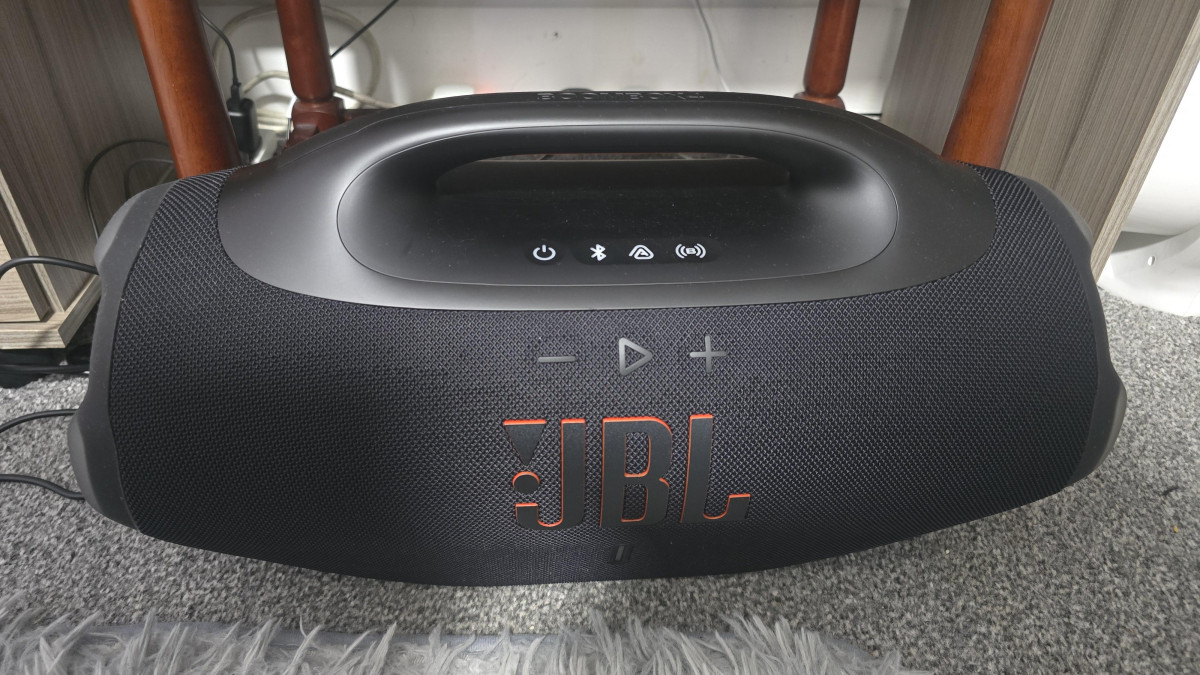
First Impressions: A Speaker That Announces Itself Before You Even Press Play
Set the JBL Boombox 4 down on a patio table or beach blanket and it immediately reads as a statement piece rather than a background accessory. This is not a speaker you tuck into a jacket pocket or a beach bag alongside your sunscreen — it's the centerpiece of the gathering, the thing everyone gravitates toward when the music starts. If you've been searching for a portable speaker that can genuinely replace a home sound system for an afternoon, this is the category the Boombox 4 was built to dominate, and understanding exactly what you're getting into — the size, the weight, the trade-offs — will save you from any surprises once it arrives at your door.
5.89kg
Net weight
28-34 hrs
Playtime with Boost
200W+
Combined system output
IP68
Dust and water rating
Design, Build Quality, and the Physical Reality of Owning It
At just over 50 centimetres wide and roughly 26 centimetres tall, the Boombox 4 occupies real furniture-sized footprint rather than a "portable" one in the traditional sense. The classic boombox silhouette is instantly recognisable, and JBL has kept the chunky, rugged proportions that made earlier generations so photogenic at parties and campsites. What's changed under the surface is the engineering: despite looking every bit as substantial as its predecessor, this generation sheds noticeable weight thanks to a redesigned internal layout, and independent testers who placed it directly against the previous Boombox found it measurably easier to lift and carry, even though it still requires two hands and a bit of effort over any real distance since the new design switches to two smaller woofers supported by three passive radiators, trimming weight while letting the larger woofers handle more of the low-end work.
Don't mistake "lighter than before" for "light." At just under 5.9 kilograms, this is a speaker you carry from the car to the patio, not something you sling over your shoulder for a hike. One independent test team found they could comfortably manage it for a couple of blocks before their arms needed a break, which is a fair real-world benchmark for anyone imagining themselves walking any real distance with it in hand. The integrated carry handle is functional and grippy, but this is fundamentally a "point A to point B" speaker, not a walk-around companion.
The build quality itself uses recycled plastic and fabric in its construction, with eco-conscious packaging to match — a detail that matters if sustainability factors into your purchase decisions and one that positions JBL's manufacturing approach as more considered than a purely function-first product. The passive radiator grilles have been reinforced compared to earlier models, and the base has been flattened for better stability when the speaker is thumping out bass on an uneven picnic table or sandy beach surface.
Inside the Engine Room: How the Boombox 4 Actually Produces Sound
Peel back the marketing language and the acoustic architecture here is genuinely interesting for anyone who cares about how a speaker generates its sound rather than just how loud the number on the box claims to be.
The Boombox 4 uses a two-way driver system: a pair of larger woofers handling low and mid-bass frequencies, paired with a pair of tweeters for the high end, and three passive radiators (bass-reflex components that vibrate passively to reinforce low frequencies without drawing extra power) working alongside them to deepen the low end without needing a dedicated subwoofer. This is a notable architectural shift from the three-way, subwoofer-based design of the previous generation, and it's the direct reason the newer unit weighs less — fewer heavy magnet assemblies, more efficient use of space.
What "AI Sound Boost" Actually Does
Rather than a marketing buzzword with no substance behind it, AI Sound Boost is a real-time signal processing feature that continuously analyses whatever you're playing and adjusts the amplification on the fly to squeeze out maximum volume while keeping distortion in check. In practical terms, this means you can push the volume higher than you might expect from the wattage alone before things start sounding harsh or clipped — the speaker is actively managing the trade-off between loudness and clarity as the song plays, rather than applying one fixed setting regardless of content.
Two Bass Boost Modes: Deep vs. Punchy
You get a physical toggle (also accessible in the companion app) between two distinct bass character presets. Deep Bass emphasizes low-end weight and sustain — better suited to genres like house, hip-hop, or anything built around a rolling low-frequency foundation. Punchy Bass instead sharpens the attack of each bass hit for a more percussive, immediate feel, which tends to suit upbeat pop and dance tracks. Reviewers who spent extended time with both settings generally preferred Punchy for casual listening, but also noted that either mode can start to overwhelm the midrange and vocal presence at higher volumes, particularly indoors where the bass has less room to dissipate — testers found themselves gravitating away from both boost modes altogether during critical listening, because pushing either one tended to overpower the sound and reduce overall clarity. That's a genuinely useful piece of guidance for buyers: leave the boost modes off for detail-focused indoor listening, and save them for outdoor sessions where you actually need the extra low-end reach to cut through open air.
Power Output: What the Numbers Mean for Real-World Loudness
The headline output figure quoted in the product's own specifications reflects the RMS rating per individual woofer, but the full picture is more impressive once you add up the whole driver array. When running on mains power, each woofer is rated at 65 watts RMS with each tweeter contributing 40 watts RMS, and on battery power that drops only slightly to 60 watts RMS per woofer — meaning the complete system pushes out well over 200 watts combined when plugged into a wall socket, and close to that figure even when running purely on battery. That battery-power consistency is the detail worth paying attention to: plenty of portable speakers quietly throttle their output when unplugged to protect battery life, but this one barely compromises, which is exactly why it earns comparisons to speakers that are typically twice its size.
For context on why that matters: this is genuinely loud enough to fill a garden, a beach stretch, or a living room without strain, and multiple independent testers confirmed it can comfortably cover a full house party or a sizeable backyard gathering without needing to be pushed anywhere near its ceiling — reviewers found it capable of filling an entire house party or a large backyard, loud enough that a neighbour's noise complaint became a genuine possibility rather than a joke. If your listening space is a small apartment bedroom, this is significant overkill; if it's an outdoor space where sound needs to travel and compete with ambient noise, it's built exactly for that job.
Battery Life and Charging: The Marathon Numbers
JBL rates the Boombox 4 at up to 28 hours of continuous playback on a single charge, extendable to roughly 34 hours using the Playtime Boost mode, which trades a small amount of audio fidelity and maximum volume headroom for significantly extended runtime — a smart feature to keep in your back pocket for multi-day camping trips or long outdoor events where a power outlet simply isn't an option. Independent lab testing has actually validated these claims rather generously: one testing team measured a full 34 hours and 56 minutes of continuous playback at a realistic 80dB listening level with Deep Bass mode engaged, exceeding JBL's own advertised figure and confirming that the harder the speaker has to work — the louder and bassier the content — the faster that runtime shrinks, which is standard behaviour but worth keeping in mind if you're planning to run it at party volume rather than casual background levels.
Two details make the battery story here genuinely differentiated from most competitors. First, the battery pack is swappable and user-replaceable — it uses the same battery format as JBL's PartyBox 520, meaning owners can buy and carry a spare pack for extended off-grid sessions, and years down the line, a tired battery doesn't mean buying a whole new speaker. Second, the internal battery itself is a substantial 99Wh lithium-ion pack, which is why a full recharge via the included AC cable takes around three hours despite the size.
One practical point worth flagging clearly: the included charger tops out at 10 watts, and this speaker does not support USB Power Delivery fast charging. In practice this means the fastest, most reliable way to refill the battery is through the bundled AC power cable plugged straight into a wall outlet rather than expecting a quick top-up through a phone-style fast charger. Buyers used to speedy USB-C charging on smaller gadgets should adjust their expectations accordingly and plan charging sessions the night before a big event rather than assuming a lunchtime top-up will get them very far.
Connectivity, Compatibility, and the App Question
The Boombox 4 connects via Bluetooth 5.4, JBL's most current wireless standard, which brings improved connection stability and lower power draw compared to older Bluetooth generations. Range and reliability in everyday use have held up well in independent testing across JBL's current speaker lineup, with connections staying solid even through walls and multiple rooms.
For anyone who cares about audio fidelity beyond what Bluetooth compression allows, the USB-C port doubles as a wired, lossless audio input — plug in a compatible laptop or source device directly and you bypass Bluetooth compression entirely. That same USB-C port can also be used in reverse, as an emergency charging source for your phone, though naturally at the cost of the speaker's own battery reserves.
Auracast support is one of the more forward-looking features here. It replaces JBL's older PartyBoost pairing system and allows you to either pair two Boombox 4 units together for genuine left/right stereo separation, or broadcast your audio to any number of other Auracast-compatible JBL speakers within range, without the fuss of pairing each one individually. This is a meaningfully more flexible system than the point-to-point pairing most competing speakers still rely on.
Two connectivity gaps are worth calling out plainly, because they'll matter to specific buyers: there is no 3.5 mm auxiliary input on this model, so anyone hoping to plug in an older MP3 player, a wired mixer, or a device without Bluetooth will need to rely on the USB-C wired connection instead. And while the product listing states an app is needed for use, in practice this mainly governs access to deeper controls — EQ adjustment, Auracast setup, bass mode switching, and battery status — rather than basic Bluetooth pairing and playback, which work through the physical controls on the unit itself. Compatibility itself is broad: the speaker pairs over standard Bluetooth with iPhone, iPad, iPod, and Android devices alike, so this isn't an ecosystem-locked purchase.
Waterproofing and Durability
The IP68 rating here is the top tier of ingress protection commonly found on consumer electronics, covering both total dust protection and resistance to sustained submersion, not just splashes. In practical terms, that means poolside spray, a sudden rain shower at an outdoor barbecue, or sand kicked up on a beach blanket simply aren't a concern. Independent testers have found similarly-rated JBL speakers in this generation capable of being fully submerged for extended stretches without issue, which gives real confidence for anyone planning to use this near open water rather than just tolerating the occasional splash.
Who the JBL Boombox 4 Is Built For — and Who Should Look Elsewhere
This speaker makes the most sense for:
- Hosts who regularly organize backyard barbecues, pool parties, or larger outdoor gatherings and want genuine room-filling, yard-filling volume without renting a PA system
- Campers and off-grid travellers who value the swappable battery system and don't mind the weight in exchange for multi-day runtime
- Buyers who want a speaker that can double as an outdoor party centerpiece thanks to Auracast multi-speaker linking
- Anyone upgrading from a smaller, quieter portable speaker who has consistently wished for more volume headroom and deeper bass reach
This is probably not the right choice for:
- Anyone who needs true one-hand portability for hiking, commuting, or daily carry — the weight and dimensions rule that out
- Listeners in apartments or small indoor spaces, where this level of output and bass emphasis will be more than the room can comfortably handle
- Buyers who rely on a wired 3.5 mm aux connection for older devices without Bluetooth or USB-C
- Audiophiles chasing precise midrange detail and vocal clarity above raw bass impact and outdoor loudness — this is a party speaker first, a critical-listening speaker second
How the Boombox 4 Stacks Up Against the Competition
Direct competitors fall into two camps: JBL's own smaller, lighter sibling for buyers who don't need this much size and power, and premium rivals from other brands chasing the same "big outdoor speaker" category.
| Feature | JBL Boombox 4 | JBL Charge 6 | Bose SoundLink Max |
|---|---|---|---|
| Weight | ~5.89 kg | ~960 g | ~2.13 kg |
| Rated battery life | Up to 28 hrs (34 hrs boosted) | Up to 24 hrs (28 hrs boosted) | Up to 20 hrs |
| Water/dust rating | IP68 | IP68 | IP67 |
| Multi-speaker pairing | Auracast | Auracast | Stereo/Party pairing |
| 3.5mm aux input | No | No | Yes |
| Best suited for | Large gatherings, outdoor parties, maximum volume | Portable daily-carry outdoor use | Premium mid-size portability with wired flexibility |
JBL's own Charge 6 pairs Bluetooth 5.4 with a much smaller footprint and roughly a kilogram of total weight, making it the far more grab-and-go option if you don't actually need boombox-scale volume — it's the speaker for someone who wants long battery life and rugged durability in something that fits in a backpack side pocket, not a centerpiece for a large gathering.
Bose's SoundLink Max, meanwhile, weighs in at just under five pounds with a rated 20-hour battery life and IP67 durability, and unlike the Boombox 4, it retains a 3.5 mm aux input alongside USB-C — a meaningful advantage for anyone still relying on wired sources. However, it's a fundamentally smaller, less powerful unit that can't match the Boombox 4's raw output or bass extension, and it comes at a comparable premium price point despite offering noticeably less speaker for the money in terms of sheer scale and wattage.
For buyers who specifically want more light-show spectacle, karaoke functionality, or a speaker designed to stay planted in one spot rather than travel, JBL's own PartyBox lineup sits a tier above the Boombox 4 in size and features, trading portability for an even bigger sound system experience — worth a look if the Boombox 4's outdoor-portable format isn't actually a priority for how you plan to use it.
Strengths and Trade-Offs: The Honest Picture
The Boombox 4's greatest strength is how little it compromises battery output for portability — you genuinely get near-full power whether it's plugged into the wall or running purely on its internal battery, which isn't something every competitor in this price bracket can claim. The swappable battery system is a rare and genuinely valuable long-term ownership feature; most portable speakers become e-waste the moment their internal battery degrades, while this one can simply have its power pack replaced. Auracast support future-proofs the speaker for multi-unit setups in a way that older pairing systems don't, and the IP68 rating means you truly don't need to think twice about weather or water exposure.
Against that, the honest weaknesses are worth stating plainly. The bass emphasis, while impressive for outdoor use, can genuinely overshadow midrange clarity and vocal presence at higher volumes, particularly indoors — this is a speaker tuned for outdoor bass impact first, indoor tonal balance second. The lack of a 3.5 mm aux input will frustrate anyone still relying on wired legacy devices. And while the weight reduction compared to the previous generation is real and measurable, this remains a two-handed, short-distance-carry speaker rather than a true grab-and-go companion — buyers picturing themselves walking it any real distance should recalibrate those expectations before purchase.
The Verdict: Should You Buy the JBL Boombox 4?
If your use case is genuinely outdoor and genuinely social — barbecues, pool days, camping trips, garden parties, or any scenario where you need a speaker to fill open space with confident, room-shaking bass rather than sit quietly on a bedside table — the JBL Boombox 4 earns its place as one of the strongest options in this category, backed by a battery system that outperforms its own marketing claims and a driver design that manages to get louder and lighter at the same time. Buy it if size, weight, and indoor tonal precision aren't dealbreakers for you. Skip it if you need true single-hand portability, a wired aux connection, or a speaker built primarily for critical indoor listening rather than outdoor volume — in those cases, a smaller sibling like the Charge 6 or a rival like the Bose SoundLink Max will serve you better.
What People Say
4 commentsBoombox 4
The sound quality is good overall, though it could be even better. It slightly lacks mids, but the highs are clear and crisp, and the bass is strong and satisfying. Through the app, you can adjust the equaliser exactly how you like, and it also offers two bass modes: Deep and Punchy, which is a nice feature depending on your listening preference.
Connectivity is more than enough for me — it connects to my device within seconds and has been very reliable, so I’m very happy with that.
Battery life depends on how loud you play it. At full volume, it lasts around 3–4 hours. I haven’t tested it much on low volume yet, but overall, for a speaker of this size and power, the battery performance is good enough.
As for the design, I like it a lot. Personally, I find it much more attractive than the Boombox 3.Overall, I’m happy with the product and would recommend it to buy.
Magnificent
I bought this boombox two weeks ago, and I can say clarity -100%. Bass - 100% . Exceptionally durable - over 100%. I can host a house party all night with this ( enough playtime). I love it.
Best in class best in quality and best in service.
It’s one of the best speaker that I have in my collection.
And argos had done a really good gob on delivering it on time as promised.
Keep up the good job.
Great Boombox 4
I decided to go for this and I was never disappointed. It money worth, I enjoy the Bluetooth connectivity, the bass & the durability.